Modems...
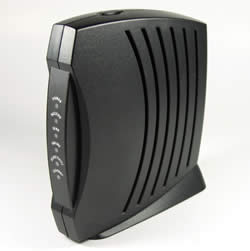
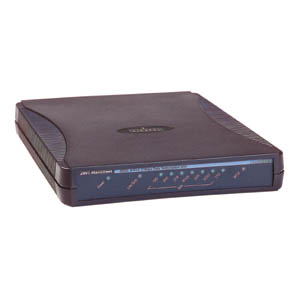
Modem, short for modulator-demodulator is an electronic device that converts a computer’s digital signals into specific frequencies to travel over telephone or cable television lines. At the destination, the receiving modem demodulates the frequencies back into digital data. Computers use modems to communicate with one another over a network.
The modem has significantly evolved since the 1970s when the 300 baud modem was used for connecting computers to bulletin board systems (BBSs). With this type of modem each bit, represented digitally by a 1 or 0, was transmitted as a specific tone. The receiving modem responded with its own dedicated frequencies so that the modems could “talk at the same time.” The technical term for this type of modem is asynchronous.
While the 300 baud modem could transmit about 30-characters per second, fast enough for text-based BBSs, people were soon sharing programs and graphics. This required faster modems, and the modem went through many incarnations in rapid succession over the following three decades. By 1998 the standard dial-up modem maxed out its transmission range at 56 kilobits per second. While many tens of times faster than the 300-baud modem, far greater speeds could yet be reached with an Asymmetric Digital Subscriber Line (ADSL) modem.
Analog Signals
Analog signals are continuous electrical signals that vary. Most of the time, the variations follow that of the non-electric (original) signal. Therefore, the two are analogous hence the name analog.
Example:
Telephone voice signal is analog. The intensity of the voice causes electric current variations. At the receiving end, the signal is reproduced in the same proportion. Hence the electric current is a ‘MODEL’ but not one’s voice since it is an electrical representation or analog of one’s voice.
Digital Signals
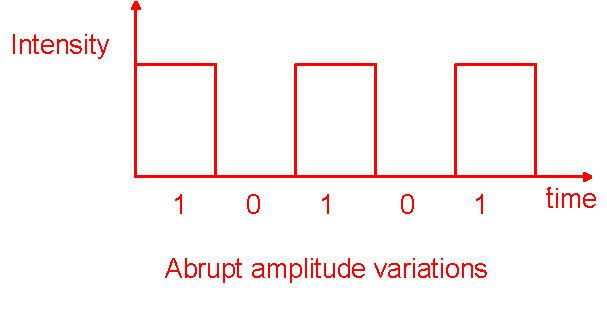
Digital signals are non-continuous, they change in individual steps. They consist of pulses or digits with discrete levels or values. The value of each pulse is constant, but there is an abrupt change from one digit to the next. Digital signals have two amplitude levels called nodes. The value of which are specified as one of two possibilities such as 1 or 0, HIGH or LOW, TRUE or FALSE and so on. In reality, the values are anywhere within specific ranges and we define values within a given range.